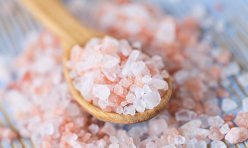
Gourmet salts such as the popular Himalayan pink salt contain a number of trace elements, which include essential minerals and toxic metals.
While salt manufacturers make many health claims related to the abundance of minerals in those expensive products (read more..), the amount of toxic elements is usually not mentioned.
In fact, neither of these trace elements, whether toxic metals or essential minerals (read more..), are present in the gourmet salts in significant amounts.
The table below shows a range of the highest in trace elements of gourmet salts and the tolerable maximum limits of these toxins for comparison.
Also Listed is “table salt” information. Table salt is usually stripped from most trace elements during processing. Aluminium is often added in the form of aluminosilicate. (read more..)
Maximum amounts of toxic elements found in various gourmet salts
| Toxic elements | Arsenic | Cadmium | Chromium | Mercury | Nickel | Lead | Thallium | Vanadium |
|---|---|---|---|---|---|---|---|---|
| Table salt | n/d | n/d | 2 | n/d | 2 | 0.44 | 0.84 | n/d |
| Salts most abundant of specific element. | Kala Namak Black Mineral Salt | Himalayan Pink Fine Mineral Salt | Alaea Hawaiian Sea Salt | Kala Namak Black Mineral Salt | Himalayan Pink Fine Mineral Salt | Sel Gris De Guerande | Fumee de Sel Chardonnay Oak Smoked Salt | Kala Namak Black Mineral Salt |
| Maximum of any salt (mcg/g) | 0.1 | 0.093 | 2.6 | 0.18 | 3.6 | 1.3 | 1.6 | 1.9 |
| Tolerable rate of toxic elements for adults as per various recommendations | 3 mcg/kg of body weight / week (1) | 7 mcg/kg of body weight / week (2) | 150mcg/kg of body weight / week (3) | 1.6mcg/kg of body weight / day (2) | 1,000mcg per adult / day (4) | 50mcg/kg of body weight / week (5) | Upper limit not available. | 1,800mcg per adult / day (4) |
| How many grams of salt an adult of 75kg would have to consume daily to reach the maximum safe level of this element? | 321 | 806 | 4,326 | 95 | 277 | 412 | n/a | 947 |
NOTE ON THALLIUM
Although there are currently no specific safety guidelines for intake of Thallium, the International Programme on Chemical Safety Task Group has estimated that dietary thallium of approximately 11 mcg/day is unlikely to cause adverse health effects.
I have therefore set a reference intake of 11mcg/day as a daily reference intake for the above table (not an upper safe limit since it is not known. (3)
As an example that population in UK intakes about 0.7-0.8 µg/day from the diet. In the case of Thallium, 1 gram of the most thallium abundant salt contains 1.6mcg of this element. This would represent only about 7% of what is known as a daily safe intake.
The row “Maximum amount (mcg) per gram of salt” shows the maximum amount of each toxic element found in one gram of any salt.
Please note the row with the maximum tolerable rate of toxic elements for adults. Some recommendations are shown as mcg/kg of body weight per week and some as mcg of body weight per day. These depend on the how the recommendations are formulated for each specific element.
The last row in this table shows an example of how much a 75kg person would have to consume of a particular salt to reach the toxic level of each element.
This calculation only takes into consideration the intake of salt. Food and water also contribute to the daily intake of these elements.
In the table, however, it is shown that the amount of toxic metals in gourmet salt is significantly below the upper safe level, even in the most mineral abundant salts.
Gourmet salt is usually consumed by sprinkling it on our food at the table or sometimes in cooking.
It is not added to processed foods. The amount of salt that we consume at the table whether it is either table salt or gourmet salt is about 1 gram per day.
For additional explanation, please see section “How much of table salt do we eat per day?” in the article “Are the aluminium contents in table salt harmful?”.
NUTRITION FACTS VS NUTRITION MYTHS
You will find a summary of the most common nutrition myths and evidence-based nutrition facts here.