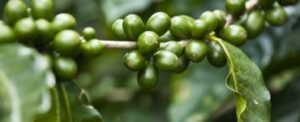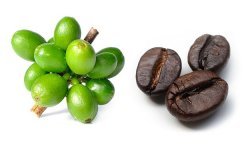
Studies have shown that roasting coffee reduces drastically the levels of one of the most significant antioxidants called chlorogenic acid (CGA).
The degree of destruction increases with temperature and time of roasting with green coffee beans (raw beans) containing the highest levels of CGAs and dark roasted beans the lowest levels. (1, 2)
There are other antioxidants however, arguably equally important, called Maillard reaction products (MRPs) which are formed in the process of roasting beans. MRPs are most active when coffee beans are roasted medium-dark. (3, 4)
Which antioxidants and in what quantities are more important for our health is not known for certain, and more research is needed.
Roasting coffee destroys 70%-94% of CGAs depending on the way it was roasted.
Some studies show that there is a difference of concentration of CGAs between green beans and their roasted versions. From the following examples, it is possible to see that the dark roasted coffee has lost most of its CGAs. (1, 5)
- Green Arabica coffee: 4.6g of CGA per 100g of dry beans;
- Lightly roasted Arabica coffee (used usually for filter coffees): 1.7g of CGA per 100g;
- Dark roasted Arabica coffee (used usually for espresso machines): 0.3gof CGA per 100g.
Side notes:
- It is not possible to know exactly how many CGAs we are getting from the coffee that we are drinking, since the concentration of CGAs varies considerably between different types of coffees (and teas).
Concentration of CGAs depends on several factors: (6, 7)
- Whether coffee is brewed from green beans or from roasted beans;
- What type of bean varieties are used (e.g. Robusta has more CGAs than Arabica);
- Brewing methods;
- Time and temperature of roasting of beans.
- Adding milk to coffee reduces the available CGAs by an additional 40%. (8)
- Regular drinking of coffee made of roasted beans has many health benefits, regardless of reduced CGAs.
NUTRITION FACTS VS NUTRITION MYTHS
You will find a summary of the most common nutrition myths and evidence-based nutrition facts here.